domingo

Conclusiones


Después de haber tratado el tema en este blog se concluye que la información obtenida en la Red se limita a noticias, dibujos, esquemas e imágenes, siendo la información más útil encontrada manuales y directrices de organismos oficiales. Las verdaderas fuentes que muestran la actualidad y la importancia del tema son artículos obtenidos de revistas científicas de prestigio.

No obstante, hemos comprobado que Internet es una fuente importantísima de difusión de la información, y pudimos constatar que entre sus carencias se encuentran la organización de la información y el carácter privado de gran parte de esta.

El tema del muestreo de agua en zonas afectadas por accidentes nucleares se trata desde puntos de vista muy diferentes en Internet y en las revistas científicas, lo que nos lleva a plantearnos en qué medida la información de Internet puede ser útil para el químico. Sin duda, Internet es de utilidad para nosotros, puesto que la información de organismos oficiales se transmite por esta vía; por otra parte, el resto de noticias y en general el flujo de información hoy día es casi exclusivo de Internet. Pero es en los artículos científicos donde constatamos la actualidad e importancia del tema, y es ahí, en los textos científicos, donde el profesional puede extraer la información que necesita para llevar a buen puerto el trabajo a realizar sobre el tema.

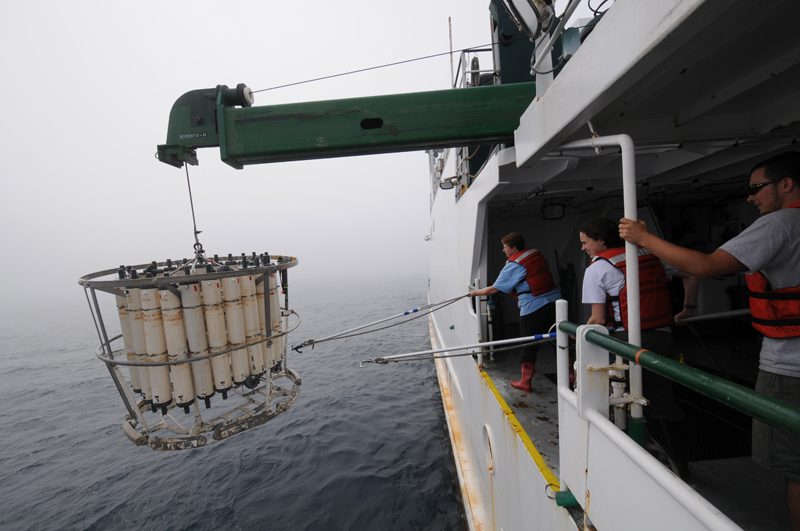
El muestreo en internet se trata con frecuencia y muy visualmente (por medio de imágenes y esquemas), lo cual es muy apropiado para identificar aparatos técnicos; en cambio, en publicaciones científicas se limitan a nombrarlo como es lógico. Además, en muchas ocasiones también se pueden encontrar vídeos de profesionales utilizando el equipo, siendo esto muy útil para su estudio.

sábado

Sampling The Pacific For Signs Of Fukushima Radiation

http://beforeitsnews.com/health/2012/04/sampling-the-pacific-for-signs-of-fukushima-radiation-1970107.html

UCB Rainwater Sampling Experimental Setup

http://www.nuc.berkeley.edu/UCBAirSampling/WaterSamplingSetup

EXTERNAL EXPOSURE TO RADIONUCLIDES IN AIR, WATER, AND SOIL

http://ordose.ornl.gov/documents/fgr12.pdf

Radioactivity in water and possible remedial measures

http://www.suro.cz/en/prirodnioz/radioactivity-in-water-and-possible-remedial-measures

Radiological Laboratory Sample Analysis Guide for Incidents of National Significance – Radionuclides in Water

http://www.epa.gov/narel/reports/WaterReport_Final_w_Cover_1-16-08.pdf

Basic Information about Radionuclides in Drinking Water

http://water.epa.gov/drink/contaminants/basicinformation/radionuclides.cfm

Handbook for Sampling and Sample Preservation of Water and Wastewater, Volume 1

Assessment of Radiation in Surface Water at the Paducah Gaseous Diffusion Plant

http://www.pgdpcab.energy.gov/Meetings/2007/February/RadiationAssess.pdf

RadNet Laboratory Data

http://www.epa.gov/japan011/rert/radnet-sampling-data.html

Japanese Nuclear Emergency: EPA's Radiation Monitoring

http://www.epa.gov/japan2011/index.html

Sampling Procedures for Isotope Hydrology

http://www-naweb.iaea.org/napc/ih/documents/other/Sampling%20booklet%20web.pdf

TRACE METAL CLEAN SAMPLING OF NATURAL WATERS

http://www.epa.gov/region6/qa/qadevtools/mod5_sops/surface_water_sampling/low_level_metals/r9surface-wtr-metals.pdf

Sampling for trace metal analysis

http://www.polartrec.com/expeditions/seawater-property-changes-in-the-southern-ocean/journals/2011-04-14

Trace Metals and Ocean Health

http://greatbeltresearchcruise.com/day-26-trace-metals-and-ocean-health/

Trace elements at sea’s skin

http://medseavillefranche2013.wordpress.com/2013/03/06/trace-elements-at-seas-skin-by-alina/

Collecting Samples

http://www.ilmb.gov.bc.ca/risc/pubs/aquatic/ambient/ambient-04.htm

Trace Metal Sampling

Fukushima Daiichi Nuclear Power Station Analysis Results of Spent Fuel Pool Water in Unit 1 to 4

Fukushima Daiichi Nuclear Power Station Analysis Results of Spent Fuel Pool Water in Unit 1 to 4

Sampling the Pacific for Signs of Fukushima

International team releases findings from 2011 cruise to measure the concentration, distribution, and biological impacts of radiation from damaged Japanese nuclear power plant

Collecting Sea Water Samples

May 2011. Supported by the Rainbow Warrior, Greenpeace experts conduct independent radiation sampling along the Fukushima coastline. In the aftermath of the Fukushima nuclear disaster these tests show how inadequate the government’s response to the disaster has been. In response to this, the Japanese government institutes its own programme of checks.

TEPCO workers collect water from Fukushima Daiichi Reactor 1 torus room

Marine monitoring

Monitoring at off-shore sampling points consists of:
  1. Measurement of ambient dose rate in air above the sea;
  2. Analysis of ambient dust above the sea;
  3. Analysis of surface samples of sea water;
  4. Analysis of samples of sea water collected at 10 m above the sea bottom.

Fukushima Day 560 - Radioative Fukushima Rain Fallout in Vancouver, Banff, Toronto and Ottawa

water sampling work in Unit 4 spent fuel pool

Water sampling from reactor 1 PCV at Fukushima Daiichi (1/3)

Water sampling from reactor 1 PCV at Fukushima Daiichi (2/3)

Water sampling from reactor 1 PCV at Fukushima Daiichi (3/3)

Inside the Fukushima Daiichi unit 1 primary containment vessel

miércoles

Fukushima (presentación)

Understanding the radioactivity at Fukushima

Radiological Monitoring and Consequences of the Fukushima Nuclear Accident (1 April 2011, 14.30 UTC)

Source and distribution of dissolved radium in the Bega River estuary, Southeastern Australia

¹³⁷Cs, ²³⁹,²⁴⁰Pu and ²⁴¹Am in bottom sediments and surface water of lake Paijanne, Finland

Absorption of radionuclides from the Fukushima nuclear accident by a novel algal strain

Different methods for tritium determination in surface water by LSC

Estimation of the Adriatic sea water turnover time using fallout Sr⁹⁰ as a radiactive tracer

Evidence of the radioactive fallout in the center of Asia (Russia) following the Fukushima nuclear accident

Fukushima fallout in northwest German environmental media

Isotopic determination of U, Pu and Cs in environmental waters following the Fukushima Daiichi nuclear power plant accident

Metadata on the radioactive contamination of environmental objects on the territories of Russia and the USSR

Monitoring of aerosol and fallout radioactivity in Belgrade after the Fukushima reactors accident

Radiactive nuclides in the Enviroment

Radioactive contamination of aquatic ecosystems following the Chernobyl accident

Radioactive impact of Fukushima accident on the Iberian Peninsula: Evolution and plume previous pathway

Release of plutonium isotopes from the Fukushima Daiichi nuclear power plant accident